
Nigeria’s Electricity Sector Under Pressure: Access Gaps, Fuel Shortages and Mounting Debt
Nigeria’s electricity sector is facing renewed strain as gas shortages, low generation capacity, and mounting debt continue to disrupt reliable power supply. With only 4,300 MW available for over 200 million people, the country’s power challenges highlight deeper structural issues in tariffs, fuel supply, and sector financing.
Nigeria — One of the largest Africa’s economy and most populous country — is once again confronting the structural weaknesses of its electricity system. Recent sector data paints a clear picture: the challenge is no longer only building power plants, but ensuring they can actually operate, be paid for, and deliver reliable electricity to consumers.
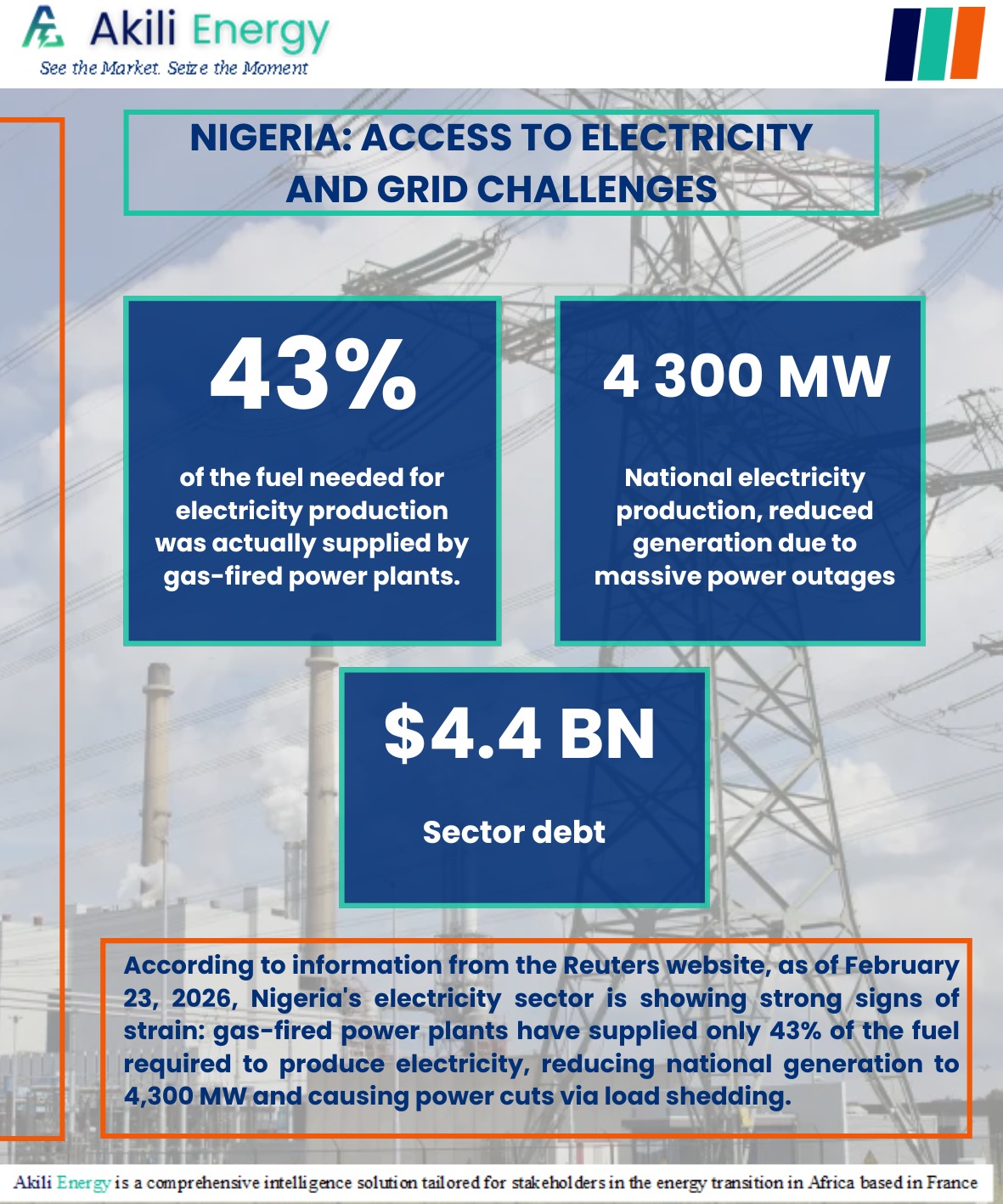
Three numbers summarize the situation:
Only 43% of the fuel required by gas-fired plants has been supplied
National electricity generation has dropped to about 4,300 MW
The sector carries roughly $4.4 billion in accumulated debt
Together, they reveal a power system trapped in a cycle of under-supply, under-payment, and under-investment.
A Gas-Dependent Power System Without Enough Gas
Nigeria’s grid relies heavily on gas-fired generation. This dependence is logical: the country holds some of the largest natural gas reserves in the world. Yet paradoxically, gas availability — not gas reserves — is the primary constraint.
Power plants are not receiving adequate fuel supply. With less than half of required gas volumes reaching generators, plants cannot run at full capacity even when installed infrastructure exists. The problem is therefore not theoretical capacity, but operational capacity.
Several factors contribute to the shortage:
Payment arrears to gas suppliers
Pipeline vandalism and infrastructure security risks
Pricing disputes within the electricity value chain
Foreign exchange constraints affecting upstream operators
In short, the Nigerian power crisis is not a generation crisis — it is a fuel and market liquidity crisis.
Why 4,300 MW Is a Serious Constraint
For perspective, Nigeria has over 200 million inhabitants. An output of 4,300 MW for the entire country is extremely low by international standards.
To illustrate:
A single medium-sized European country can use 40,000–70,000 MW.
A large modern city alone can require more than 4,300 MW.
This shortage forces the system operator to implement load shedding, meaning controlled power cuts to prevent total grid collapse. As a result:
Households rely heavily on diesel or petrol generators
Businesses face higher operating costs
Manufacturing productivity declines
Inflationary pressure increases
In reality, millions of Nigerians effectively live in a “self-generation economy,” where private generators produce more reliable electricity than the national grid.
The $4.4 Billion Debt Trap
The most critical structural issue is financial rather than technical.
Nigeria’s electricity value chain functions like a circle:
Consumers → Distribution companies → Transmission operator → Generation companies → Gas suppliers
The problem: payments weaken at each step.
Electricity tariffs are often below cost-recovery levels. Distribution companies struggle to collect bills. As revenues shrink, generators are underpaid. Then gas suppliers do not get paid — and they reduce fuel deliveries.
This creates a self-reinforcing loop:
Insufficient tariffs → Revenue shortfalls → Unpaid generators → Unpaid gas suppliers → Less gas → Less electricity → More outages → Even lower willingness to pay.
The accumulated result is about $4.4 billion in sector debt, which discourages investment and prevents maintenance or expansion.
Not Just an Energy Problem — An Economic One
Electricity reliability is a core development indicator. Without stable power:
Industrialization slows
Digital services cannot scale
SMEs face high operating costs
Healthcare and education infrastructure suffer
Nigeria’s generator dependence also has environmental consequences. Millions of small diesel generators produce significant local pollution and greenhouse gas emissions — far more inefficiently than centralized generation would.
The Real Solution: Market Reform + Diversification
Fixing Nigeria’s electricity sector will not be achieved by adding more power plants alone. The priorities are structural:
Financial reform
Cost-reflective tariffs
Improved bill collection
Targeted subsidies (not universal subsidies)
Gas-to-power reform
Payment guarantees for gas suppliers
Secured pipeline infrastructure
Contract enforcement
Grid modernization
Transmission expansion
Loss reduction
Metering improvements
Energy diversification
Distributed solar
Mini-grids for rural electrification
Hybrid systems to reduce diesel use
Nigeria does not lack energy resources. It lacks a fully functioning electricity market framework.
A Critical Moment
The current situation represents both a risk and an opportunity.
If structural reforms stall, the country risks deeper energy insecurity and rising economic costs. However, with proper policy alignment, Nigeria could become one of the most attractive electricity investment markets in Africa — thanks to its demand size, urban growth, and industrial potential.
The numbers are worrying, but they are also clarifying. They show that the challenge is solvable — not by technology alone, but by fixing the economic and regulatory foundations of the power system.
Reliable electricity in Nigeria is not merely an infrastructure goal.
It is a prerequisite for sustained economic development.