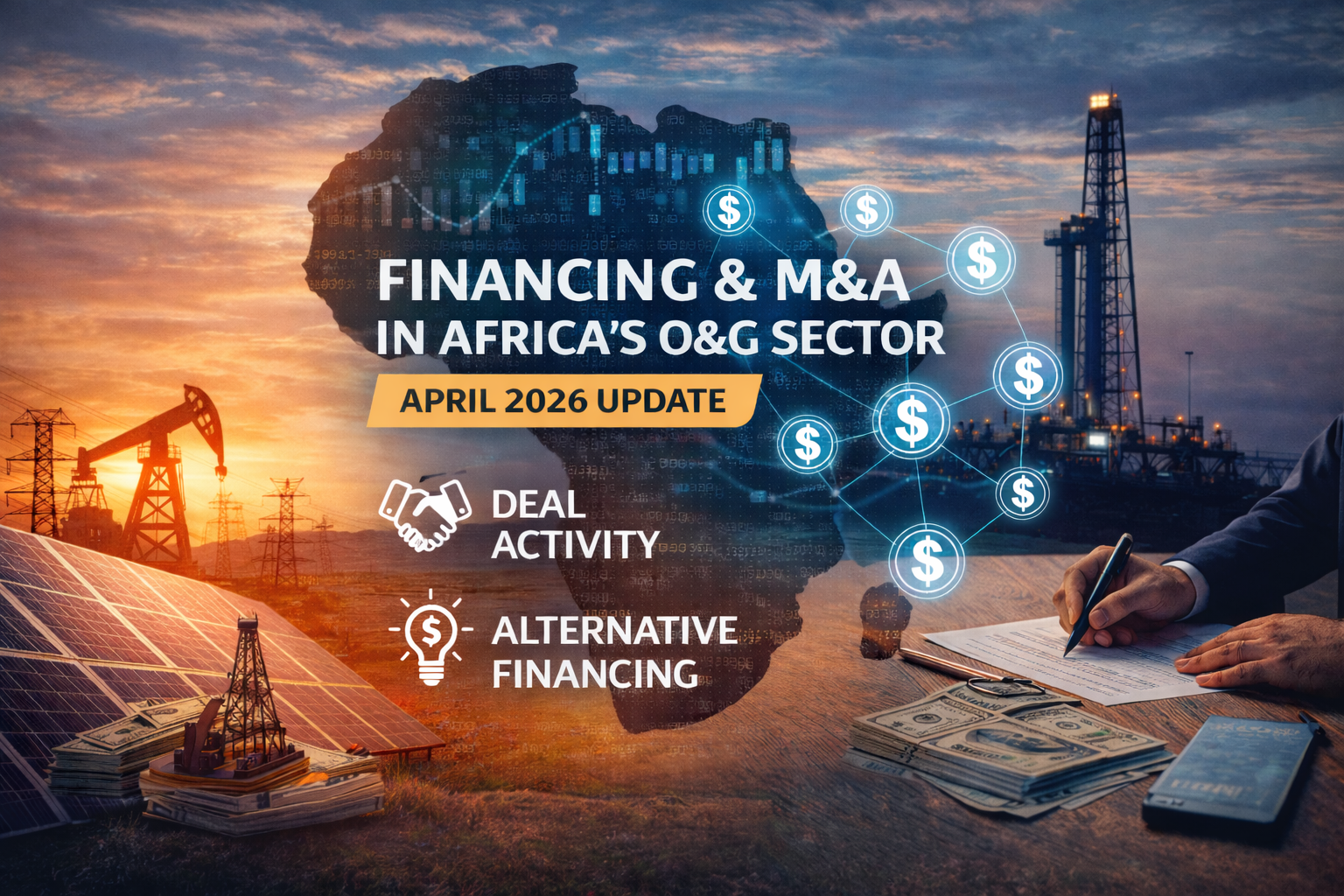
Financing and M&A Trends in Africa’s Oil & Gas Sector | February 2026 Market
Africa’s oil and gas sector continues to attract strong investment momentum despite the global energy transition. Recent financing and M&A activity across Ghana, Angola, Kenya, Senegal and Equatorial Guinea highlights a growing shift toward alternative financing structures, equity markets and commodity-linked funding.
Capital Flows, Strategic Acquisitions and the Rise of Alternative Financing Structures
Executive Summary
Africa’s oil and gas sector continues to attract significant capital despite a global shift toward energy transition. Recent transactions across Ghana, Angola, Kenya, Senegal, and Equatorial Guinea demonstrate a clear evolution in financing structures, investor profiles, and strategic positioning by both national oil companies (NOCs) and independent operators.
In February 2026 alone, $3.49 billion in capital was mobilized across financing and M&A transactions, highlighting strong investor confidence in African hydrocarbon assets. Financing activity dominated capital flows, accounting for 83% of total capital deployed ($2.879 billion), while M&A and asset acquisitions represented $609.5 million.
The key takeaway: African upstream and midstream assets remain attractive, but deal structures are shifting away from traditional project finance toward equity markets, balance-sheet financing, and commodity-linked funding structures.
1. Market Overview: Capital Deployment in African O&G
The African oil and gas investment landscape is increasingly characterized by strategic repositioning, capital restructuring, and asset optimization. A snapshot of transactions recorded in early 2026 highlights several important themes:
Total capital deployed: $3.49 billion
Financing transactions: $2.879 billion
M&A and asset acquisitions: $609.5 million
Financing share of capital: 83%
M&A share: 17%
While M&A deal count remained significant, the majority of capital flows were driven by a small number of large financing transactions, notably Tullow Oil’s refinancing and Kenya Pipeline Company’s IPO.
This concentration illustrates a broader trend: large capital restructuring transactions increasingly shape African energy markets more than traditional asset sales.
2. Financing Structures Are Evolving
One of the most notable developments in African upstream investment is the declining role of traditional project debt financing.
Instead, companies are relying on alternative capital sources including:
2.1 Equity Placements
Equity markets are becoming an important funding channel for upstream acquisitions and corporate growth.
For example:
Chariot Limited raised approximately $20 million through an oversubscribed equity placing on the London Stock Exchange.
The capital is intended to support Etu Energias’ acquisition of Blocks 14 and 14K offshore Angola.
Equity funding allows companies to maintain flexibility while avoiding restrictive debt covenants associated with traditional project finance.
2.2 Commodity-Linked Financing
Commodity-linked finance is increasingly being used to support upstream acquisitions.
A key example is:
Shell Trading providing up to $170 million in acquisition financing to Etu Energias in exchange for future offtake arrangements.
This model enables upstream companies to secure capital while guaranteeing commodity supply to trading houses.
Such structures are particularly attractive in emerging markets where traditional lenders may be cautious.
2.3 Balance Sheet and Cash Flow Financing
Several deals are financed directly from corporate balance sheets or operational cash flow.
For example:
Panoro Energy financed the $219.5 million acquisition of Kosmos Energy’s interest in Block G offshore Equatorial Guinea through its balance sheet and reserve-based lending facilities.
Similarly:
Tullow Oil financed the acquisition of the TEN FPSO offshore Ghana using in-year cash flows from the TEN fields.
This approach reflects improved financial discipline among independent operators following the commodity price volatility of the past decade.
3. Landmark Financing Transactions
3.1 Tullow Oil’s $1.285 Billion Refinancing
The largest financing transaction recorded during the period was Tullow Oil’s $1.285 billion debt refinancing, secured with senior noteholders and Glencore.
The refinancing supports:
Jubilee Field
TEN Fields offshore Ghana
The package also includes a cargo prepayment facility, a structure commonly used by commodity traders to secure future oil deliveries.
This refinancing represents a strategic move to optimize capital structure while maintaining operational stability in Ghana’s offshore assets.
3.2 Kenya Pipeline Company’s Record IPO
Another landmark transaction was the $825 million initial public offering of Kenya Pipeline Company (KPC).
Key highlights include:
Largest local-currency IPO in East Africa
65% of the company offered to investors
Oversubscription by institutional investors
Uganda acquiring a 20.15% strategic stake
The listing on the Nairobi Securities Exchange signals growing regional investor appetite for energy infrastructure assets.
The transaction also reflects a broader shift toward capital market financing for African midstream infrastructure.
4. Strategic M&A Activity
Although financing dominated total capital volumes, M&A transactions remained critical for portfolio optimization and asset repositioning.

4.1 Panoro Energy Expands in Equatorial Guinea
Panoro Energy acquired Kosmos Energy’s 40.375% non-operated interest in Block G, which includes the Ceiba and Okume complex.
Deal value:
Up to $219.5 million
Strategic objectives include:
Increasing exposure to producing assets
Strengthening cash flow generation
Enhancing portfolio diversification.
The deal highlights continued interest in mature producing assets with stable production profiles.
4.2 Angola: Consolidation of Offshore Blocks
Angola continues to see asset consolidation, with Etu Energias acquiring interests in Blocks 14 and 14K offshore.
Funding sources include:
Equity placement by Chariot
Acquisition financing from Shell
This layered capital structure illustrates the growing use of hybrid financing in African upstream transactions.
5. Government and Institutional Financing
Governments also remain active participants in energy financing.
One example is Senegal’s $749 million trade finance agreement with the International Islamic Trade Finance Corporation (ITFC) to support fuel imports and broader energy sector operations.
This highlights the continued importance of development finance institutions and trade finance facilities in supporting energy security across African markets.
6. Geographic Investment Trends
The transactions span multiple African energy hubs:
Country | Key Deals |
|---|---|
Ghana | Tullow refinancing and FPSO acquisition |
Angola | Block 14 & 14K acquisition |
Kenya | KPC IPO and drilling equipment acquisition |
Senegal | ITFC trade finance deal |
Equatorial Guinea | Panoro–Kosmos asset transaction |
Together these deals illustrate diversified investment flows across West, East and Central Africa.
7. Strategic Implications for Investors
Several key insights emerge from the recent wave of deals:
1. Financing innovation is accelerating
Companies are increasingly using commodity financing, equity markets, and balance-sheet funding.
2. Infrastructure assets are attracting capital
Midstream assets such as pipelines are proving attractive to institutional investors.
3. Portfolio rationalization continues
Major operators are divesting non-core assets while independents expand.
4. Commodity traders are becoming lenders
Trading houses like Shell Trading and Glencore are providing capital through structured financing.
5. Regional capital markets are strengthening
The KPC IPO demonstrates the growing role of African exchanges in energy financing.
8. Outlook for African Oil & Gas Financing
Looking ahead, several trends are expected to shape African energy investment:
Increased use of hybrid financing structures
Deals will likely combine equity, commodity financing, and reserve-based lending.
Growth in local capital markets
Energy infrastructure listings could become more common across African exchanges.
Continued consolidation among independents
Smaller operators will continue acquiring assets from majors exiting mature fields.
Strategic role of NOCs
National oil companies will remain central to asset development and financing partnerships.
Conclusion
Despite global energy transition pressures, Africa’s oil and gas sector remains a dynamic investment landscape. The latest financing and M&A activity highlights an industry adapting to changing capital markets through innovative financing models, strategic acquisitions, and deeper engagement with regional capital markets.
The $3.49 billion deployed across deals in early 2026 underscores continued investor confidence in the continent’s hydrocarbon potential and the strategic importance of African energy assets in global supply chains.
As financing structures evolve and regional markets deepen, Africa’s oil and gas sector is poised to remain an important arena for both energy security and investment opportunities in the years ahead.